nf-core/taxmarker
Identify taxonomically mislabelled sequences
Introduction
nf-core/taxmarker is a re-implementation of the Sativa pipeline by Kozlov et al. [2016] that identifies taxonomically mislabelled sequences. It takes as input a sequences file (aligned or unaligned) and a file describing the proposed taxonomy of each sequence. Using evolutionary placement, it identifies sequences in the alignment that do not have a phylogenetic signal that corresponds to their taxonomies.
There are slight differences between this implementation and the original in how sequences are scored as having a correct taxonomy or not.
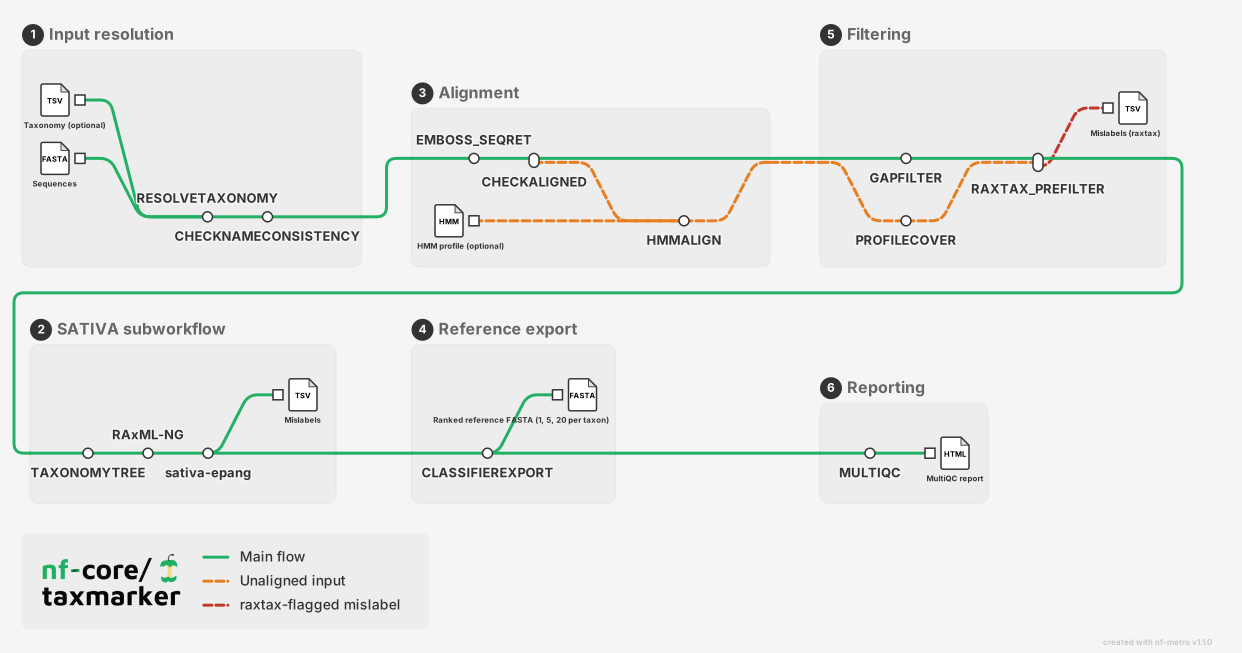
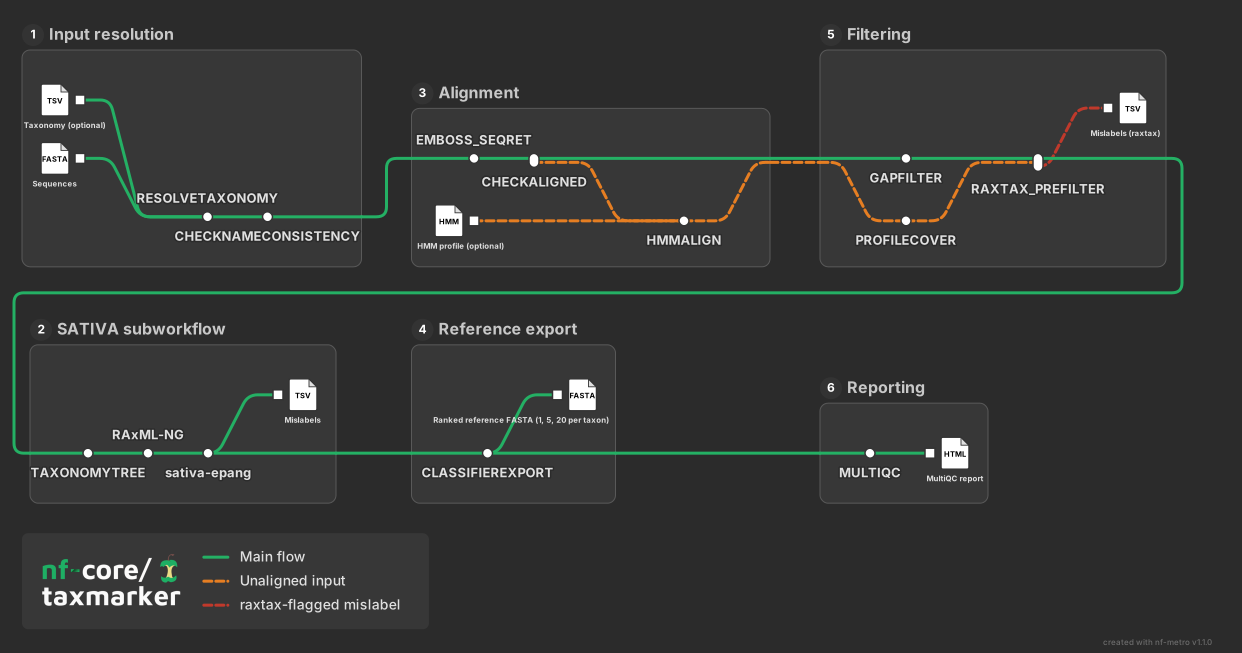
The diagram and list below describe the pipeline’s current aim, not everything that’s implemented yet. The reference-export step doesn’t exist yet. See the nf-core/taxmarker proposal and issue #9 (reference export) for current status.
- Resolve taxonomy: from
--taxonomyif given, otherwise derived from--sequencesrecord headers instead (GTDB-style:>id taxonomy;string); if both are present, the file wins, with a warning rather than silently ignoring the header text - Check that names in the two are consistent and do not contain problematic characters
- Reduce the input to one representative sequence per (cluster, taxon) pair before anything downstream sees it: an optional absolute weight cutoff (
--sequence_weights,--min_weight), then VSEARCH clustering (--cluster_identity, default1.0– a safe no-op pure dereplication), then per-cluster/per-taxon selection by sequence length and weight (disable entirely with--skip_clustering). Sequences absent from--sequence_weightsdefault to weight 1, degrading gracefully to “pick the longest sequence per taxon” with no weight table at all;--upstream GTDB(with--gtdb_bac120_metadata/--gtdb_ar53_metadata) computes--sequence_weightsautomatically from GTDB genome-quality/category/taxonomy-agreement metadata instead – see issue #15 for the design - Optionally flag likely mislabels with raxtax: quickly self-classify the reference set against its own taxonomy and report sequences it’s already confident are mislabeled – a fast mislabel-detection method in its own right, which also prefilters the much more expensive phylogenetic-placement step below by skipping sequences it has already flagged, so they never reach alignment or placement (disable with
--skip_raxtax; tune sensitivity with--raxtax_filter_rankand--raxtax_min_confidence) - If the sequences are unaligned, align them via hmmalign against an HMM profile (
--hmm,--hmm_name); already-aligned input passes straight through, detected automatically – no separate mode-switch parameter needed - Filter out sequences too short/incomplete to place reliably, reporting them separately rather than silently dropping them: by non-gap proportion for already-aligned input (disable with
--skip_gapfilter; tune with--min_nongap), or by HMM profile coverage for hmmalign-derived input (disable with--skip_profile_cover; tune with--min_profile_cover;--min_profile_cover_rescuekeeps the best fragment of a taxon that would otherwise be lost) - Optionally perform phylogenetic placement (disable entirely with
--skip_sativa, turning the pipeline into a taxonomy-resolution/alignment/prefilter QC tool – steps 1-6 above still run as configured), as the SATIVA subworkflow:- Create a bifurcating phylogeny with branch-lengths corresponding to the alignment from the taxonomy tree induced by the taxonomy file (RAxML-NG)
- Perform a leave-one-out test, placing each sequence back into the phylogeny after removing it, and score each sequence’s placement against its declared taxonomy to flag likely mislabels (sativa-epang); spread the placement over several jobs with
--folds_per_jobif you have the cluster for it (unset places every fold in one job)
- Optionally export verified reference sequences for downstream classifiers (
--export_n_per_species, e.g.1,5,20): for each number, at most that many sequences per species, ranked by weight times length, in DADA2’saddSpecies/assignTaxonomyformats and with the original headers - Summarise the run (MULTIQC)
Usage
If you are new to Nextflow and nf-core, please refer to this page on how to set-up Nextflow. Make sure to test your setup with -profile test before running the workflow on actual data.
First, prepare a sequences file and a taxonomy file:
5 50UnpCCeti ?????????? ?????????? ?????????? ?????????? G??AGAGUUUUnpSomer ?????????? ?????????? ?????????? ?????????? ??AAGAGUUUUpbRectu ?????????? ?????????? ?????????? ?????NNNNN N?GAGAGUUUUxjAloci ?????????? ?????????? ?????????? ?????????? ?????????UUyvCanif ?????????? ?????????? ?????????? ?????????? ?????????CThe sequences file can be phylip, clustal or fasta formatted, aligned or not.
Unaligned input is aligned automatically via hmmalign; pass --hmm (and --hmm_name, if that profile database holds more than one profile) to say which HMM profile to align against.
The taxonomy file should contain the same sequence names as the sequences file, be tab-separated without a header:
UnpCCeti Bacteria;Fusobacteria;Fusobacteriia;Fusobacteriales;Fusobacteriaceae;Cetobacterium;Cetobacterium cetiUnpSomer Bacteria;Fusobacteria;Fusobacteriia;Fusobacteriales;Fusobacteriaceae;Cetobacterium;Cetobacterium someraeUpbRectu Bacteria;Firmicutes;Clostridia;Clostridiales;Clostridiaceae;Clostridium;Clostridium rectumUxjAloci Bacteria;Firmicutes;Clostridia;Clostridiales;Peptostreptococcaceae;Filifactor;Filifactor alocisUyvCanif Bacteria;Fusobacteria;Fusobacteriia;Fusobacteriales;Fusobacteriaceae;Fusobacterium;Fusobacterium canifelinum--taxonomy is optional: if it’s omitted, each --sequences FASTA record’s header must instead carry the taxonomy directly after its id, GTDB’s own single-file convention:
>UnpCCeti Bacteria;Fusobacteria;Fusobacteriia;Fusobacteriales;Fusobacteriaceae;Cetobacterium;Cetobacterium ceti(Only possible for FASTA input, since phylip/clustal records have no room for it.)
If both --taxonomy and embedded header text are present, the file wins, and a warning is logged rather than the header text being silently ignored.
(Sequence name characters other than letters, digits, _, ., -, | and / will be replaced by underscores.)
Now, you can run the pipeline using:
nextflow run nf-core/taxmarker \ -profile <docker/singularity/.../institute> \ --sequences sequences.phy \ --taxonomy taxonomy.tsv \ --outdir <OUTDIR>Please provide pipeline parameters via the CLI or Nextflow -params-file option. Custom config files including those provided by the -c Nextflow option can be used to provide any configuration except for parameters; see docs.
For more details and further functionality, please refer to the usage documentation and the parameter documentation.
Pipeline output
To see the results of an example test run with a full size dataset refer to the results tab on the nf-core website pipeline page. For more details about the output files and reports, please refer to the output documentation.
Credits
The Sativa tool was originally written by Alexey Kozlov et al. (see citation below) and ported to Nextflow as nf-core/taxmarker by Daniel Lundin.
We thank the following people for their extensive assistance in the development of this pipeline:
Contributions and Support
If you would like to contribute to this pipeline, please see the contributing guidelines.
For further information or help, don’t hesitate to get in touch on the Slack #taxmarker channel (you can join with this invite).
Citations
If you use nf-core/taxmarker for your analysis, please cite the original article for the algorithm:
Phylogeny-Aware Identification and Correction of Taxonomically Mislabeled Sequences.
Kozlov, Alexey M., Jiajie Zhang, Pelin Yilmaz, Frank Oliver Glöckner, and Alexandros Stamatakis.
Nucleic Acids Research 44, no. 11 (2016): 5022–33. https://doi.org/10.1093/nar/gkw396.
An extensive list of references for the tools used by the pipeline can be found in the CITATIONS.md file.
You can cite the nf-core publication as follows:
The nf-core framework for community-curated bioinformatics pipelines.
Philip Ewels, Alexander Peltzer, Sven Fillinger, Harshil Patel, Johannes Alneberg, Andreas Wilm, Maxime Ulysse Garcia, Paolo Di Tommaso & Sven Nahnsen.
Nat Biotechnol. 2020 Feb 13. doi: 10.1038/s41587-020-0439-x.