nf-core/moleculardynamics


👩💻 I’m working on it, so please be patient.















Introduction
nf-core/moleculardynamics is a bioinformatics pipeline for running molecular dynamic simulations (MD) using GROMACS open-source software. This workflow enables researchers to perform standard protein simulations in a fully automated manner, with minimal configuration, on both local and high-performance computing (HPC) environments.
We are currently working on the following tasks:
- 🚀📆 Official release of the
nf-core/moleculardynamicspipeline. - 🛠👩💻 Expanding the pipeline’s capabilities to include more analysis modules (e.g., RMSF, distances), and integrating specialized tools for membrane proteins and protein-ligand complexes.
- 📚📝 Generating a comprehensive test dataset.
Pipeline
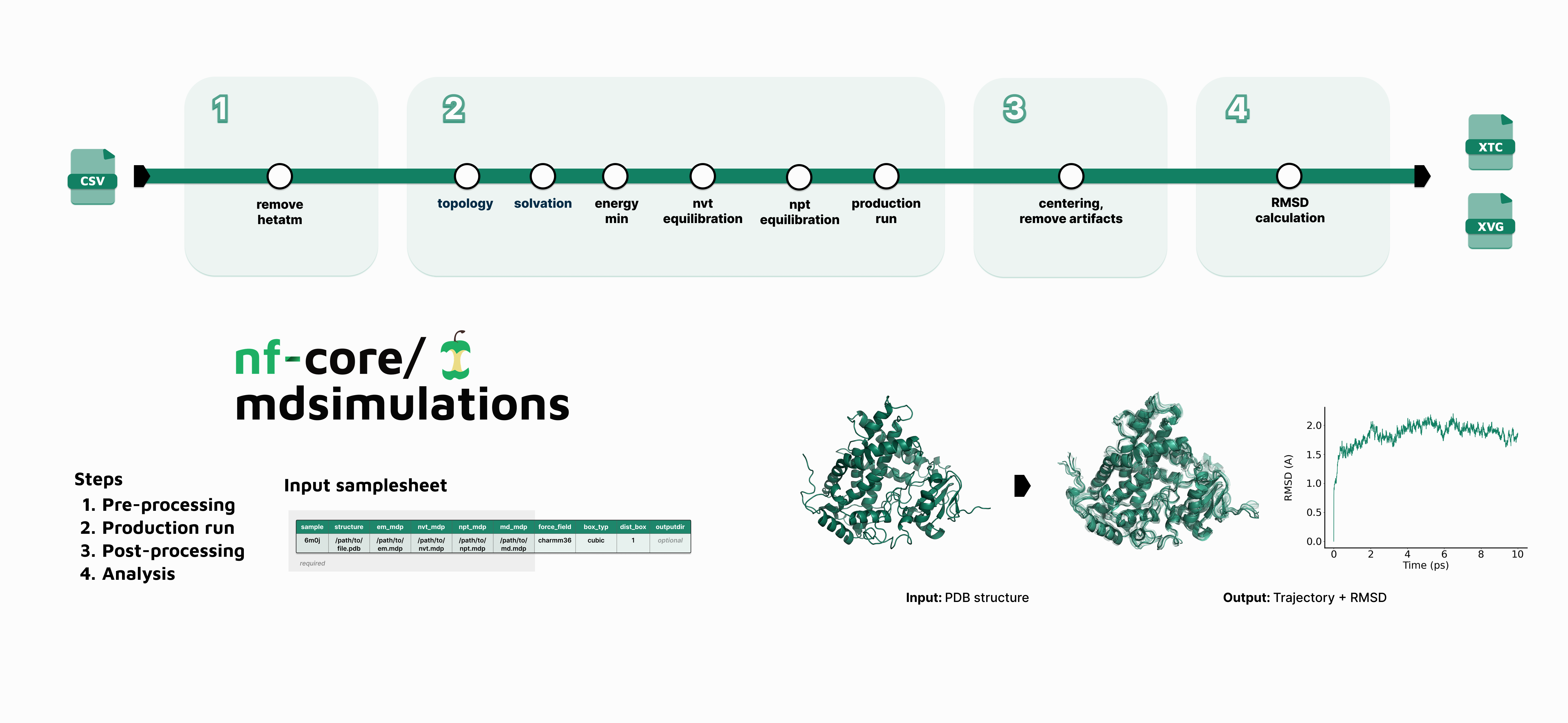
The nf-core/moleculardynamics pipeline automates a standard GROMACS MD simulation workflow. The major steps are:
- Input pre-processing: From the PDB structure, remove the missing atoms.
- Production run: Main subworkflow of the pipeline.
- Generation of molecular topology,
- System solvation, and ion addition to neutralize the system.
- Energy Minimization: Removal of steric clashes and relaxation of the initial structure.
- Equilibration: NVT (constant Number, Volume, Temperature) and NPT (constant Number, Pressure, Temperature) equilibration to bring the system to the desired temperature and density.
- Production MD: Execution of the main molecular dynamics simulation.
- Post-processing: Centering the protein and remove periodic boundary condition (PBC).
- Analysis: Preliminary analysis of the Root-Mean-Square Deviation (RMSD).
Usage
[👩💻 working on it]
If you are new to Nextflow and nf-core, please refer to this page on how to set-up Nextflow. Make sure to test your setup with -profile test before running the workflow on actual data.
Please provide pipeline parameters via the CLI or Nextflow -params-file option. Custom config files including those provided by the -c Nextflow option can be used to provide any configuration except for parameters; see docs.
For more details and further functionality, please refer to the usage documentation and the parameter documentation.
Pipeline output
[👩💻 working on it]
To see the results of an example test run with a full size dataset refer to the results tab on the nf-core website pipeline page. For more details about the output files and reports, please refer to the output documentation.
Credits
nf-core/moleculardynamics has been developed by Sara Tolosa Alarcón (@sarata00) from the Computational Biology Group at the Barcelona Supercomputing Center under the deCYPher project and supervision of Miguel Romero-Durana (@migromero).
Contributions and Support
[👩💻 working on it]
If you would like to contribute to this pipeline, please see the contributing guidelines.
For further information or help, don’t hesitate to get in touch on the Slack #moleculardynamics channel (you can join with this invite).
Citations
[👩💻 working on it]
An extensive list of references for the tools used by the pipeline can be found in the CITATIONS.md file.
You can cite the nf-core publication as follows:
The nf-core framework for community-curated bioinformatics pipelines.
Philip Ewels, Alexander Peltzer, Sven Fillinger, Harshil Patel, Johannes Alneberg, Andreas Wilm, Maxime Ulysse Garcia, Paolo Di Tommaso & Sven Nahnsen.
Nat Biotechnol. 2020 Feb 13. doi: 10.1038/s41587-020-0439-x.